
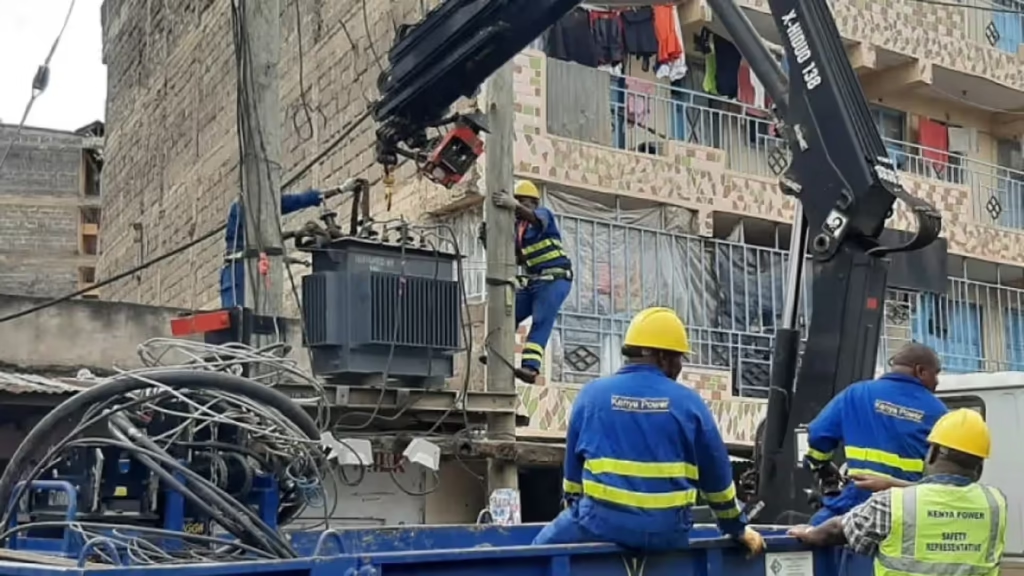
President William Ruto has announced that Kenya will begin power rationing between 5pm and 10pm daily to address increasing electricity demand and grid pressure. The announcement marks a return to load shedding, a practice Kenya has struggled with in the past but now faces again as peak demand outpaces reliable supply. The President noted that Kenya needs an investment of about Ksh 1.2 trillion to meet current and future power requirements. This has sparked national debate on whether the country is truly facing a power shortage, and what role alternative energy sources like Heavy Fuel Oil (HFO) and Industrial Diesel Oil (IDO) can play, especially for small and medium enterprises (SMEs), factories, and manufacturing plants.
Understanding Power Rationing and Load Shedding
Power rationing refers to the deliberate scheduling of electricity distribution to reduce strain on the power grid when supply cannot meet demand. It involves temporarily cutting power in specific regions or sectors during high-demand hours to prevent a total system collapse. On the other hand, load shedding is an operational measure used by utility companies like Kenya Power to reduce the load on the electrical grid when there is insufficient generation, transmission, or distribution capacity. In simple terms, load shedding is a controlled power outage designed to maintain system stability.
Both terms are often used interchangeably, but technically, power rationing is a planned policy decision by the government or regulator, while load shedding is an operational response by grid managers to an imbalance between supply and demand. The newly announced schedule from 5pm to 10pm is meant to manage evening peak demand when most households and industries are consuming electricity simultaneously.
A Look Back: The History of Power Rationing in Kenya
Power rationing in Kenya is not new. It has appeared periodically since the 1980s, particularly during drought years when hydroelectric power output drops. The worst episode occurred in the year 2000, when prolonged drought and limited generation capacity led to a nationwide load shedding program lasting several months. The economic losses from that period were significant, especially for industrial sectors that rely heavily on continuous power.
In the early 2010s, Kenya invested heavily in geothermal and wind energy through KenGen and IPP (Independent Power Producer) partnerships to reduce dependence on hydro sources. The commissioning of the Lake Turkana Wind Power Project and the Olkaria Geothermal Plants greatly improved generation capacity and reduced load shedding incidents. However, growth in electricity demand, urbanization, and industrial expansion have once again stretched supply during peak hours. Recent infrastructure issues, transmission constraints, and delayed completion of new power projects have contributed to renewed concerns.
Why the 5pm to 10pm Window?
According to Kenya Power, this evening window is when the national grid experiences the highest load. Office buildings, factories, schools, and households are all active, causing a sudden spike in demand. At the same time, solar generation tapers off after sunset, leaving the system dependent on hydro, geothermal, wind, and thermal sources. When any of these sources underperform due to weather, maintenance, or capacity issues, the grid operator must either shed load or risk a system-wide blackout.
Is Kenya Really Experiencing a Power Shortage — What Does EPRA Say?
The question of whether Kenya is truly facing a power shortage is best answered by data from the Energy and Petroleum Regulatory Authority (EPRA). According to EPRA’s Energy and Petroleum Statistics Report (2022–2024), Kenya’s total electricity generation has continued to grow, but so has peak demand.
The 2023/2024 EPRA report shows that Kenya generated 13,684.63 GWh of electricity in the year ending June 2024, up from 13,289.63 GWh the previous year, representing a 2.98% increase. However, peak demand also rose to 2,177.13 MW on February 21, 2024, compared to 2,149 MW recorded in December 2022. This means that while total generation is increasing, so is the stress during high-demand hours.
EPRA’s data also show that Kenya’s installed generation capacity stood at about 3,695 MW as of mid-2024, with a mix of geothermal (943.7 MW), hydro (872.4 MW), thermal (636.1 MW), wind (436.1 MW), and solar (442.9 MW). On paper, this capacity appears sufficient, but actual available power is often lower due to maintenance outages, droughts affecting hydro dams, and transmission losses. The regulator also notes that reliability indices have declined, with more frequent blackouts in 2023 and 2024 due to heavy rains, infrastructure damage, and network instability.
In essence, Kenya is not chronically short of electricity overall, but it faces acute shortages during peak evening hours and localized constraints in transmission and distribution. EPRA’s findings align with President Ruto’s decision to ration power between 5pm and 10pm, as that is the most critical period when grid stress peaks.
Kenya Power, KenGen, KETRACO, and the Grid Challenge
Kenya’s electricity system involves several key players. Kenya Power manages distribution and billing, KenGen is the main generator of electricity, KETRACO (Kenya Electricity Transmission Company) handles high-voltage transmission infrastructure, and EPRA regulates the entire energy sector.
Despite improvements in installed capacity, several transmission lines are yet to be completed or fully operational, particularly those linking new power plants to the main grid. KETRACO has made progress on key projects like the Loiyangalani–Suswa transmission line that connects the Lake Turkana Wind Power project, but other planned lines have faced delays. The result is that power generated in certain regions cannot always reach high-demand centers like Nairobi and Mombasa efficiently.
Additionally, regional factors affect supply reliability. The completion of Ethiopia’s Grand Renaissance Dam (GERD) has introduced potential for electricity trade within East Africa. Ethiopia has already begun exporting surplus power to neighboring countries, and Kenya could benefit from these imports during periods of shortfall. However, grid interconnection infrastructure and pricing agreements still need to mature for this to be a dependable solution.
How Heavy Fuel Oil (HFO) and Industrial Diesel Oil (IDO) Can Help
As Kenya grapples with evening load shedding and power rationing, attention has turned to alternative energy sources such as Heavy Fuel Oil (HFO) and Industrial Diesel Oil (IDO). These fuels have long been used in backup generators and thermal power plants, and while they are costlier and less environmentally friendly than renewable sources, they can serve as crucial stopgaps.
HFO is a residual fuel derived from crude oil distillation and is commonly used in large industrial boilers, power plants, and marine engines. IDO, on the other hand, is a lighter, more refined diesel variant used in industrial burners and smaller generation units. Both can be utilized to generate electricity for SMEs, factories, and manufacturing plants that cannot afford downtime during load shedding.
For SMEs and factories, HFO and IDO provide several key advantages:
- Reliability: They ensure continued operations during the 5pm to 10pm rationing window, preventing production losses.
- Scalability: Businesses can install modular generator units that match their energy needs.
- Quick deployment: Unlike solar or wind projects that require infrastructure, fuel-based generators can be set up rapidly.
- Economic continuity: By maintaining output, industries avoid layoffs and contract penalties due to downtime.
Many industrial zones in Kenya, including Athi River, Thika, and Mombasa, already use HFO-based captive power plants to supplement grid electricity. As power rationing intensifies, more firms are expected to adopt hybrid systems that integrate renewables during the day and fuel-based power in the evenings.
The Economic and Environmental Balancing Act
While HFO and IDO offer short-term relief, their use raises environmental and cost concerns. Thermal generation using fossil fuels emits more greenhouse gases and contributes to air pollution. Kenya has made commitments under the Paris Agreement to transition toward cleaner energy sources, with more than 80% of its electricity currently coming from renewables. Expanding reliance on HFO and IDO must therefore be managed carefully, focusing on efficiency and emission controls.
Nevertheless, experts argue that short-term use of these fuels is justified if it prevents industrial disruption and supports grid stability. In the long run, Kenya can blend these options with increased renewable generation and regional interconnection through Ethiopia, Uganda, and Tanzania.
The Way Forward
To sustainably end load shedding and power rationing, Kenya must address both supply and infrastructure challenges. This means:
- Accelerating investment in transmission lines and substations through KETRACO.
- Supporting KenGen and independent producers to bring new geothermal and solar projects online.
- Promoting local manufacture of energy-efficient appliances to reduce demand during peak hours.
- Encouraging industries to adopt hybrid systems that combine solar, grid, and fuel-based power for reliability.
- Engaging regional partners such as Ethiopia to strengthen cross-border power trade.
President Ruto’s acknowledgment of the current energy stress is an important step. The transparency allows policymakers and private investors to align efforts toward bridging the gap. The long-term solution lies in expanding renewable generation, modernizing the grid, and diversifying Kenya’s energy mix.
Conclusion
Kenya’s current phase of power rationing and load shedding highlights the growing tension between economic growth and infrastructure capacity. While EPRA data show that generation is rising, demand is rising even faster, especially during evening peaks. Until new capacity and transmission infrastructure catch up, HFO and IDO will remain practical fallback options for industries and SMEs.
The announcement by President Ruto signals both a challenge and an opportunity. It challenges Kenya to innovate and invest, and it provides a chance for policymakers, regulators, and businesses to rethink energy resilience. With strategic planning and a balanced approach to both renewables and backup fuels, Kenya can navigate the current rationing period and emerge with a stronger, more reliable power system for the future.